
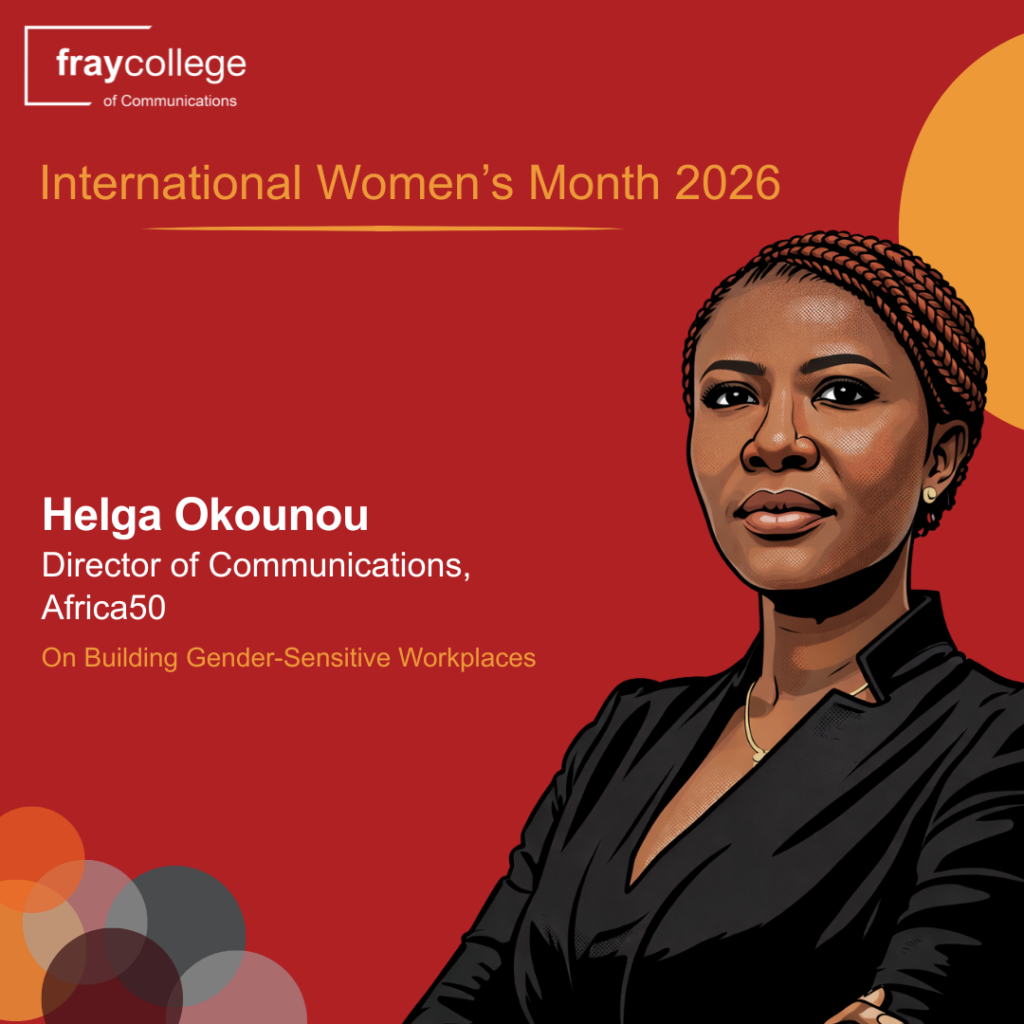
In this conversation, Helga Okounou, Director of Communications at Africa50, discusses how to create real structural transformation to build gender-sensitive workplaces, hold leaders accountable, and shape the future of women’s leadership.
Part 1: About Helga Okounou
- What are you most passionate about in your role at Africa50, and what part of your work gives you the most energy?
I joke that my role is at the crossroad of pressure and purpose, and this is exactly what makes it so energizing! What I’m most passionate about in my job is the focus on Africa. It is an opportunity to help shape a new narrative for the continent, how Africa tells its own infrastructure story. Africa50 is an infrastructure investor, and part of my work is to position Africa50 in high-level conversations, supporting leadership voices, crafting new theme territories that are important not only for the institution but for the continent. Eventually, you witness how the right message can unlock trust, partnerships and ultimately investment. As my boss says all the time, Africa’s needs are huge and urgent. This is enough to wake up every morning and come to work energized.
- What do you know now about being a woman in leadership that you wish you had known at the start of your career?
With experience, I learned that confidence comes from trusting your judgment not from perfection and that setting boundaries is not optional. If I had understood that sooner, I would have been less hard on myself, but to be totally honest, I’m grateful and happy where I am today and would not trade it.
- What is one leadership habit, ritual or mindset that has helped you stay grounded and effective, especially in high pressure environments?
Every morning, I start my day by reflecting and setting intentions before proceeding with any tasks. I believe that moving forward with purpose is essential, regardless of whether one always succeeds. Embracing failure, learning from setbacks, and progressing are fundamental aspects of growth. Facilitating high performance within a team begins with self-awareness and clarity about one’s direction. It is important to ensure that your decisions do not negatively impact others, and it is also important to take responsibility for your own actions and to empower your team to succeed. Only God can support you through that journey.
Part 2: On representation, transformation and gender sensitivity
- As a woman in leadership at an institution as significant as Africa50, how do you use your position and influence to advocate for a gender sensitive, equal and safe workplace?
I personally believe that to create an inclusive environment, every employee has a role to play. Earlier in my career, I noticed that men did not need to “advocate for men” or influence to be heard or to share ideas. So, in all my roles, I have tried to make sure that no one has to fight for this basic space. I make room for different perspectives, I challenge the status quo, above all, a safe workplace is about making sure men and women have the same access to being heard, respected and included. It is an everyday modelling job.
- Many organisations have improved representation at senior levels, but structural transformation often falls behind. In your view, what does it take to move from visibility to real institutional change?
I think moving from visibility to real institutional change starts with recognising that representation is simply the first signal, not the finish line. If you bring diverse voices into senior roles but the systems and behaviours inside the room do not change, you have done nothing. Each senior leader within an organization should be made accountable for this shift, not only women.
Transformation happens when the way we work changes: each process, each meeting, each decision reflects the diversity we claim or the diversity that we see in numbers.
- What practical steps can organisations take to institutionalise gender sensitivity so that it is embedded in systems, policies and culture, rather than dependent on individual champions?
First, define what it is that you want to be as an institution; it needs to be reflected in policies and procedures, for example, processes for recruitment, evaluation, promotion and grievance handling. Make it transparent, then make it measurable with clear KPIs, so that it is not the problem of only 5 employees.
- Issues such as the gender pay gap and workplace harassment remain persistent across sectors. What accountability mechanisms or leadership approaches do you believe are essential to ensuring that workplaces are not only inclusive but genuinely fair and safe?
I think that fairness and safety only become real when people genuinely trust the system. People trust what they can see, and sometimes their emotions influence their perception. When data on pay, promotions and how complaints are handled are transparent, it is very hard not to act on disparities. Leaders must be accountable and stand by their team as well, making sure. they stand for what is right and fair. If the employees feel they are treated with fairness, it enables a safe environment too.
- This Women’s Month, what kind of future do you hope we are building for the next generation of women entering leadership across the continent?
A future where they step into leadership roles knowing they deserve it and because their perspective also strengthens decisions, culture and institutions and not to meet quotas (because we need a woman in the boardroom). We need to normalise having women in all sectors and at all levels, it should not be seen as an exception.
