
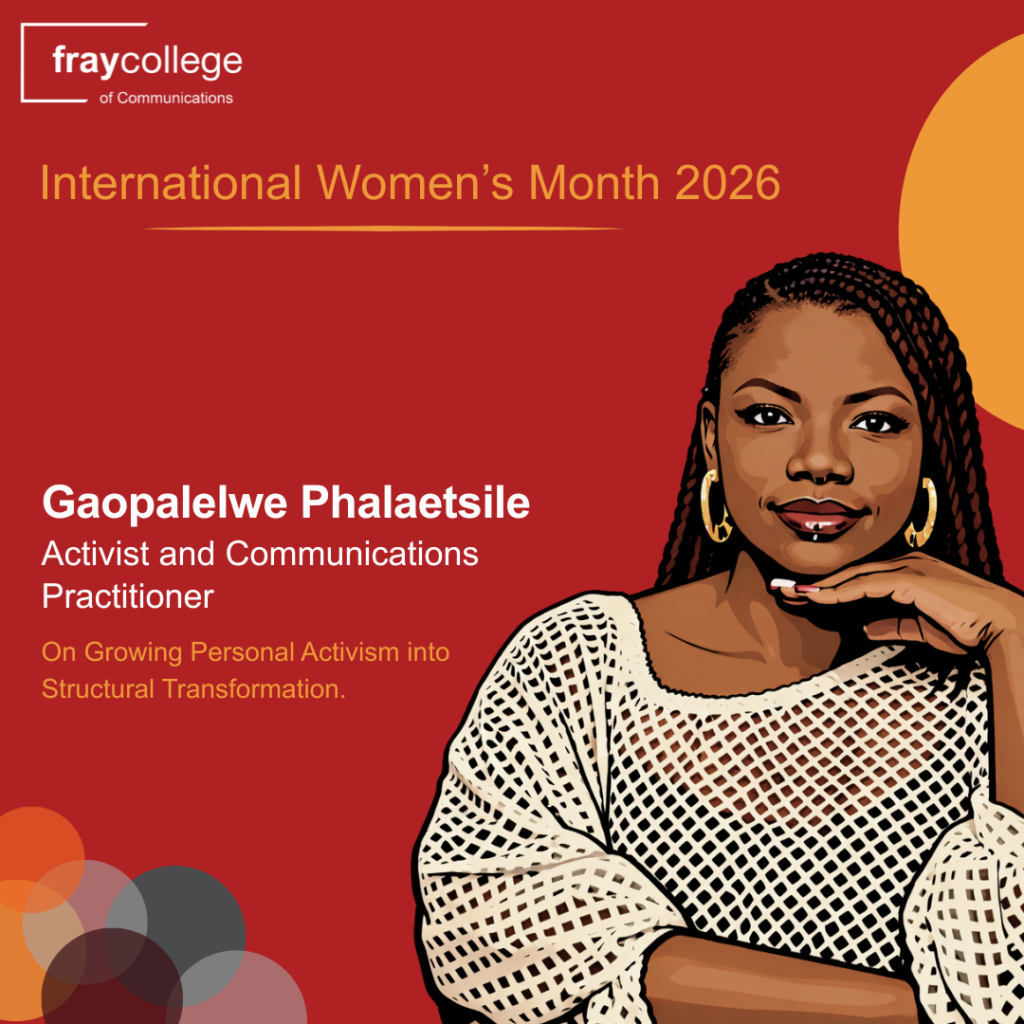
In this conversation, Gaopalelwe Phalaetsile, an activist and communications practitioner, reflects on turning personal activism into structural transformation, sharing how values-driven action can build gender-sensitive workplaces.
Part 1: About Gaopalelwe
- What are you most passionate about in your role, and what part of your work gives you the most energy?
I am most passionate about storytelling and communication that helps people think more deeply about justice, dignity, and equality. Much of my work and activism has involved using content, whether through writing, campaigns or public conversations, to create spaces where difficult issues can be spoken about honestly. What gives me energy is when storytelling does more than raise awareness. When the stories we tell begin to shift how people understand power, responsibility and care in their communities, that is when communication becomes a tool for social change.
- What do you know now about being a woman in leadership that you wish you had known at the start of your career?
I wish I had known earlier that leadership does not mean having all the answers. Often it means asking difficult questions and holding onto your values, even when it is uncomfortable. As a woman, I have also had to grapple with finding and owning my voice. Many leadership spaces still expect women to shrink themselves, to speak carefully or to soften their convictions. I am still learning to resist that. Feminist leadership, for me, is about the ongoing work of refusing to shrink and learning to speak with honesty and courage.
- What is one leadership habit, ritual or mindset that has helped you stay grounded and effective, especially in high pressure environments?
For me it is constantly returning to purpose, community and the feminist principles that guide my work. Feminist organising can be emotionally heavy because it requires confronting violence, inequality and injustice in very direct ways. Those principles remind me that the work is not about individual recognition or personal visibility. It is about collective struggle, accountability, and solidarity with others, whose voices continue to be marginalised. Returning to those values helps me stay grounded and focused on why the work matters.
Part 2: On activism, transformation and gender sensitivity
- How do you develop a strong sense of your own values and turn them into meaningful activism?
Values often emerge from lived experience and from witnessing injustice around us. Feminist activism asks us not only to recognise inequality but to question the systems that sustain it. Turning values into action means refusing silence, building solidarity with others, and creating spaces where women and marginalised communities can speak about their realities without fear. Safe spaces are important in the struggle for justice.
- Your work spans activism, communication, and institutional advocacy. How did you develop such a strong sense of values and commitment to gender justice?
My commitment to gender justice grew from listening closely to people’s lived experiences and recognising how often those experiences are dismissed, normalised or pushed into silence. Many forms of inequality are treated as private problems, when in fact they are deeply political and structural. Activism for me is about challenging systems of power that shape whose lives are valued, whose voices are heard, and who is allowed to live with dignity. That includes women, girls, queer people and others who are marginalised by patriarchal systems. Over time I realised that communication, storytelling and advocacy can play a powerful role in feminist work. The stories we tell and whose voices we amplify shape how societies understand injustice. Creating space for people to name their realities, and refusing silence around harm, is an important step toward accountability and change.
- What does it take to turn personal activism into organisational or systemic transformation?
Many movements begin with personal experience. When people encounter injustice in their own lives, it often becomes the moment that pushes them to ask deeper questions about the systems around them. For me, feminist organising began in spaces of care, where women and gender non-conforming people could come together, support one another and speak openly about issues that were often silenced. Over time those conversations have grown into collective action. When people organise, share knowledge and refuse stigma, what begins as community support can start to influence institutions, policy and public debate. What I have learned is that systemic change is never the work of one person. It happens through sustained collective organising, solidarity and the courage of many people who insist that dignity, care and justice must shape the systems that govern our lives.
- What are some practical ways you have seen your presence and activism transform workplace culture or systems?
Often the shift begins with raising questions that have long been avoided. Asking how gender shapes power in a workplace, how policies affect women differently, or how silence can enable harm. Even small moments of accountability can open space for broader conversations about equality, dignity, and justice in the workplace.
- How can employees use their influence change even when they are not in leadership positions?
Influence does not only belong to those in formal leadership roles. Workers shape culture every day through the choices they make and the values they insist on. Employees can challenge harmful norms, support colleagues who experience injustice, and continue raising questions about fairness and accountability. Collective courage often begins with small acts of resistance.
