
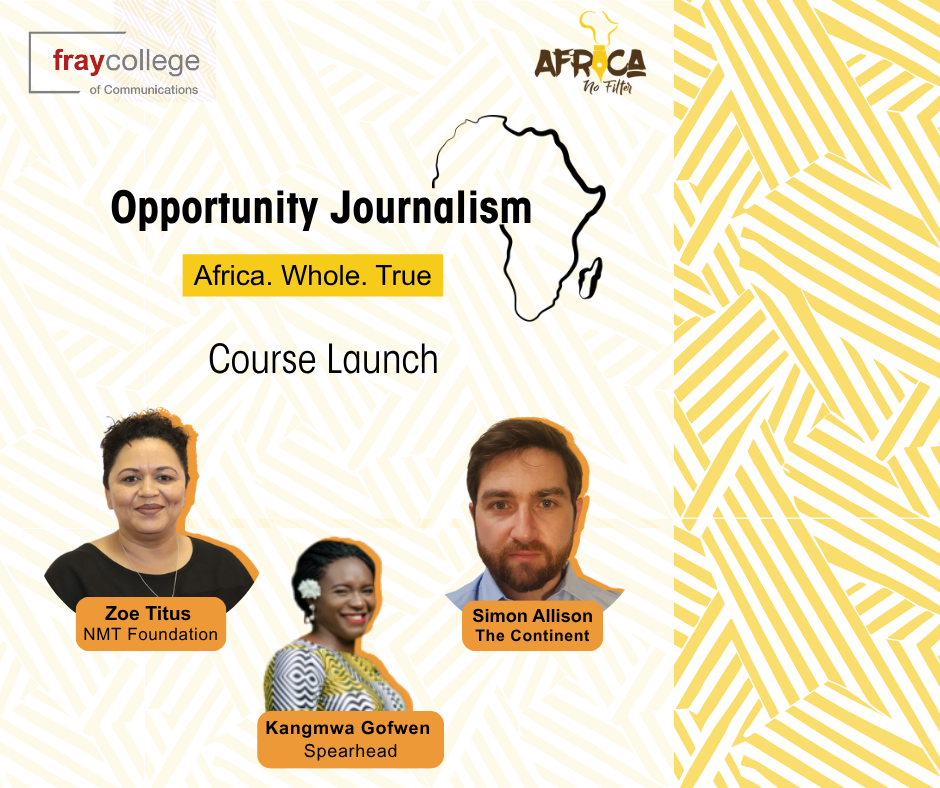
We have officially launched our new course, Opportunity Journalism, in partnership with Africa No Filter. To introduce the course, we hosted a webinar where we shared the course outline, discussed the vital role journalists play in shaping narratives about Africa, and the impact of negative storytelling. The webinar featured a panel discussion with Simon Allison, co-founder and editor-in-chief of The Continent; Zoe Titus, executive director of the Namibia Media Trust; and Kangmwa Gofwen, a reporter at Spearhead. The panellists shared personal challenges they experienced and recognised that hinder narrative change.
Mamaponya Motsai, fraycollege CEO, opened the session by highlighting the need to decolonise the way we write about Africa and examining how colonial mentalities affect how we see ourselves as a community. She spoke about how the public is increasingly turning away from the media because they feel misrepresented, as well as the economic cost of negative and stereotypical storytelling. Lerato, Head of Communications at African No Filter, echoed this sentiment, sharing that Africa pays an estimated USD 4.2 billion annually in overinflated interest rates compared to other countries, partly due to stereotypical storytelling. She urged journalists to move away from conflict- and crisis-driven narratives and instead tell stories with greater context and nuance.
Following these reflections, Paula Fray, founder of fraycollege, introduced the course Opportunity Journalism. Opportunity Journalism is a course developed to challenge the dominant crisis-driven narratives often associated with reporting on Africa and to encourage more contextual, nuanced, and balanced storytelling. While acknowledging that conflict, corruption, and crisis on the continent are real and must be reported, she explained that constantly framing Africa solely in terms of crisis creates incomplete narratives that leave audiences fatigued, disengaged, and distrustful of the media. The course encourages journalists and communicators to rethink editorial habits, sourcing, framing, and story structures to surface agency, complexity, and forward momentum, while maintaining accountability and journalistic rigour.
The panellists discussed the impact of colonial language and media systems on reporting about Africa and emphasised the importance of centring African voices in storytelling. Zoe Titus reflected on how colonialism not only shaped borders and economies but also affected information systems and the perception of whose voices are valuable. She pointed out that many African media systems adopted editorial practices that frame African storytelling in a crisis-centred way. Additionally, she highlighted that African editors, filmmakers, researchers, and storytellers across the continent are not only victims of these narratives but are also actively challenging these internalised views, despite facing limited institutional support and resources.
Simon Allison shared personal experiences working with Western publications, describing how African stories were often only considered newsworthy when tied to violence, crisis, or celebrity scandal. He explained that these experiences motivated the creation of The Continent. He mentioned that there is a growing demand for audiences to see themselves reflected in stories. This includes a need for storytelling that centres Africa as a continent, highlighting the unique contexts of individual African countries, and telling global stories through an African lens. Kangmwa Gofwen added that challenging colonial narratives must begin with education and the foundations of journalism itself, arguing that African journalists often inherit ways of framing stories that reinforce Western perspectives rather than African realities. Together, the panellists highlighted the importance of changing not only the stories being told, but also the systems, language, and structures that shape journalism on the continent.
Opportunity Journalism is not a way to focus on positive stories and move away from accountability reporting, but also a call for deeper, more contextual storytelling that centres African voices and perspectives. As newsrooms continue to navigate decentering Western ways of reporting, the course aims to equip journalists and communicators with practical tools to rethink how stories about Africa are framed and told.
Watch the full webinar here: https://youtu.be/bVM7oyRTeWY?si=S__XV4xrXROjT3ud
If you have any questions, consult the FAQ document here: https://fraycollege.com/opportunity-journalism-faqs/
